

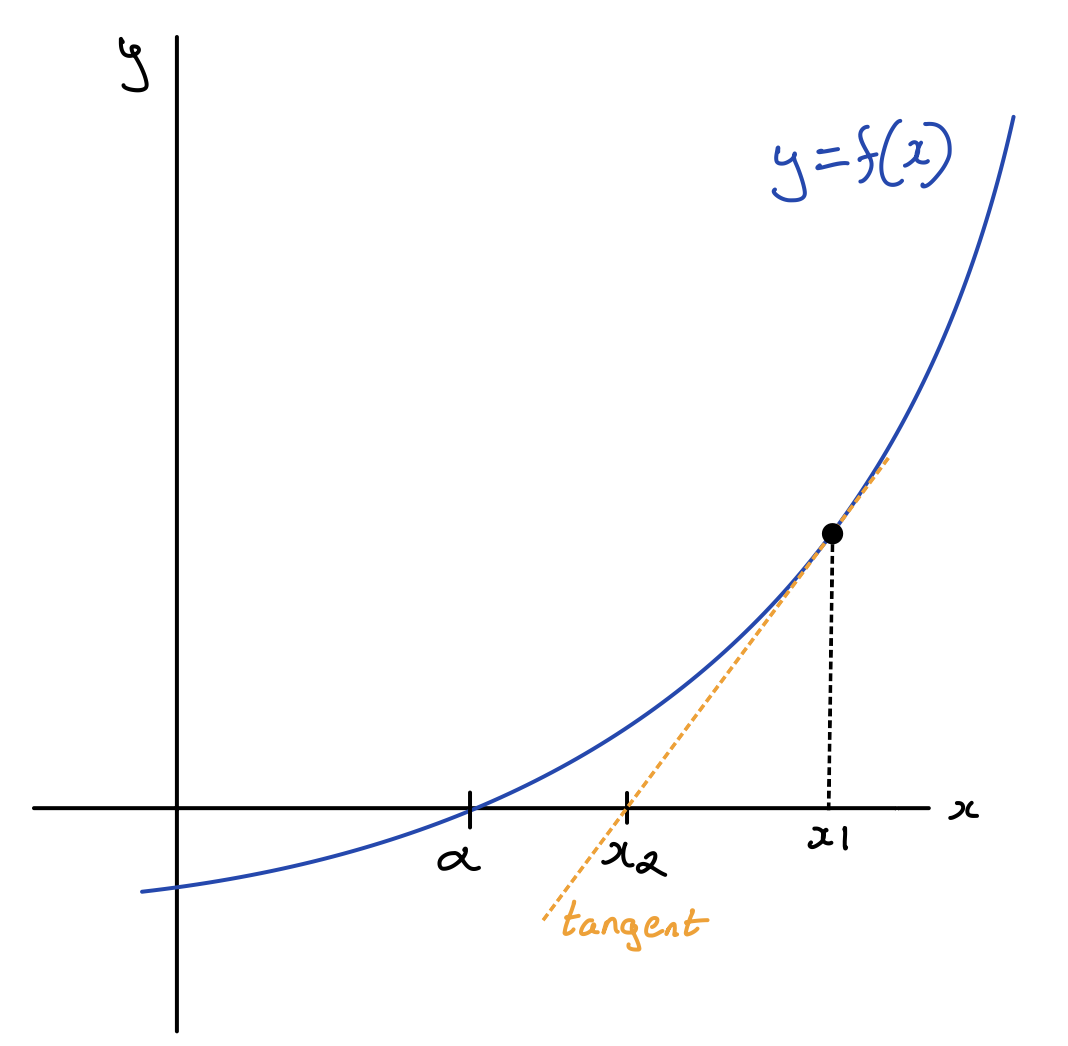
The Newton-Raphson method for finding the roots of a function makes use of the gradient.
Figure 5 below shows a function $y=f(x)$ which has a root at $x=α.$ $x_1$ is an initial approximation to this root. A better approximation to the root can be found by using the tangent to the function at $x=x$. The location where the tangent intercepts the $x$-axis, $x_2$ is closer to the root than $x_1$.
We can find an expression for $x_2$ by considering the equation of the tangent. The tangent has gradient $f^\prime(x)$, and meets the curve at $(x,f(x))$. Hence, using the formula $y−y_1 = m(x−x_1)$, the equation of the tangent at $x_1$ is
\[y - f(x_1) = f^\prime(x_1)(x-x_1)\]$x_2$ is the location where the tangent intercepts the $x$-axis $(y=0)$. Therefore,
\[0 - f(x_1) = f^\prime(x_1)(x_2-x_1)\]Rearranging to give an expression for $x_2$,
\[x_2 = x_1 - \frac{f(x_1)}{f^\prime(x_1)}\]This procedure can be repeated to find better approximations to the root by turning the equation above into an iterative sequence,
\[x_{r+1} = x_r - \frac{f(x_r)}{f^\prime(x_r)}\]What are the limitations of this method?
There are situations in which the Newton-Raphson method will not find the root of a function.
- Using the Newton-Raphson method may produce a value of $x_r$ which is outside the domain for which the function is defined. If this occurs, it is not possible to find further values of $f(x_r)$ or $f^\prime(x_r)$ and get back to the root, so the method fails completely.This is illustrated in NUMBER below. The function $y = f(x)$ is defined for $[a,b]$. Using the Newton-Raphson method starting at $x_1$ gives a value for $x_2$ that is outside the interval $[a,b]$.
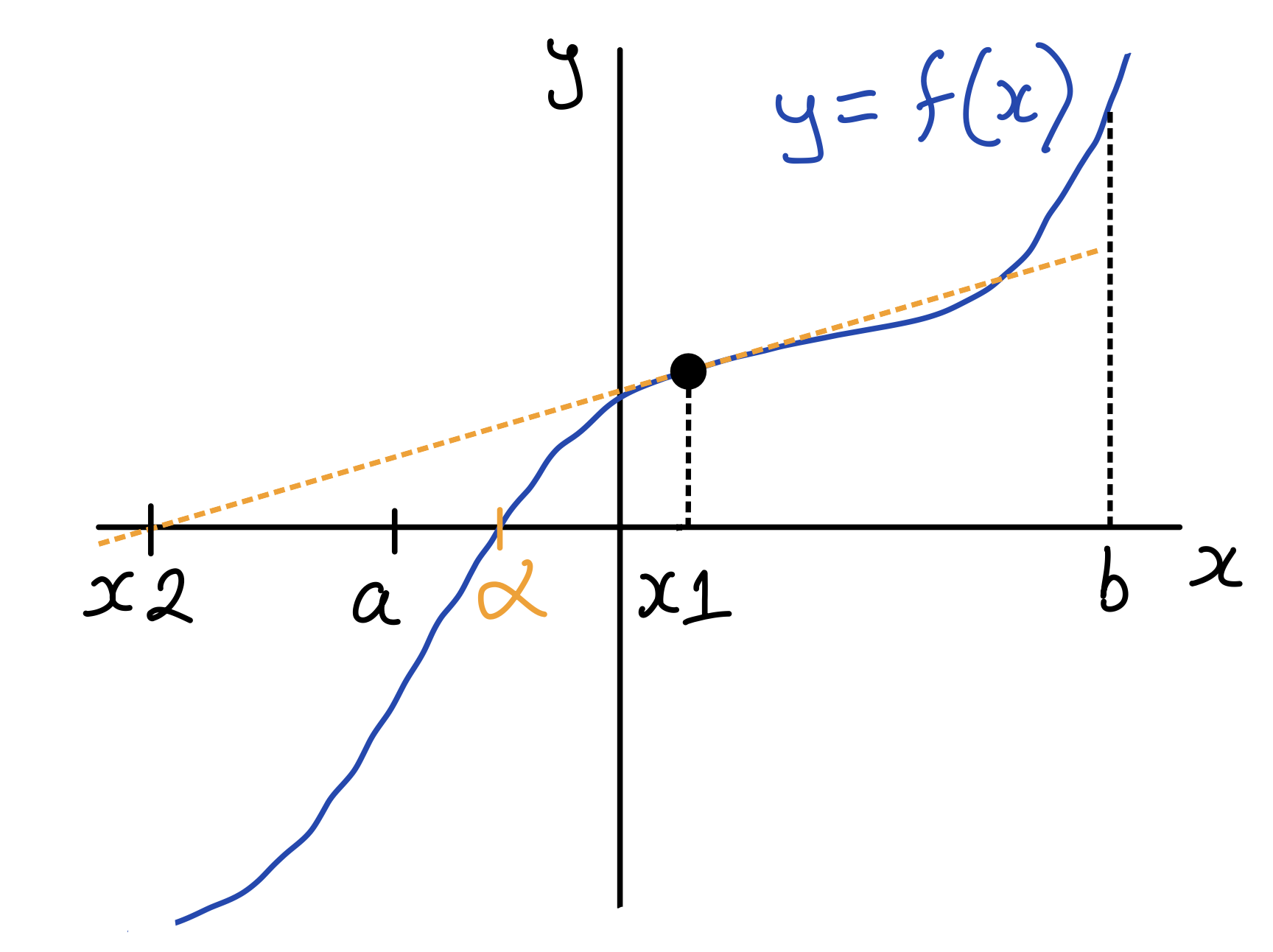 A case where the Newton-Raphson method fails: $x_2$ is outside the domain of $f(x)$.
2.
Algorithm
Below is the pesudocode for the algorithm that implements Newton Raphson.
INPUT initial approximation po; tolerance TOL; maximum number of iterations No.
OUTPUT approximate solution p or message of failure.
Step 1 Set i = 1.
Step 2 While i ≤ No do Steps 3-6.
    Step 3 Set p = po - f(po)/f'(po). (Compute pi.)
    Step 4 If |p =po| < TOL then
        OUTPUT (p); (The procedure was successful.)
        STOP.
    Step 5 Set i = i +1.
    Step 6 Set po = p. (Update ро.)
Step 7 OUTPUT ('The method failed after No iterations, No =', No);
(The procedure was unsuccessful.)
STOP.
In Python you can do this with
import numpy as np
x = np.linspace(0, 10, 100)
print(x[:5])